Wednesday, March 26, 2008

Less Futon, More Reform

So there I sat in Good Friday service, Struck. As I heard the charges against Jesus read from Luke I was amazed at the idea of Jesus as a revolutionary.

They all asked, "Are you then the Son of God?" He replied, "You are right in saying I am." Then the whole assembly rose and led him off to Pilate. And they began to accuse him, saying, "We have found this man subverting our nation. He opposes payment of taxes to Caesar and claims to be Christ, a king." So Pilate asked Jesus, "Are you the king of the Jews?" "Yes, it is as you say," Jesus replied. Then Pilate announced to the chief priests and the crowd, "I find no basis for a charge against this man." But they insisted, "He stirs up the people all over Judea by his teaching. He started in Galilee and has come all the way here."

He was so vehemently flying in the face of the established Judaisms that they had to kill him. He was a radical. I was resolute. Upon returning home after my Easter vacation, I would be more subversive. More radical. More Christlike.

As soon as I got home, I went to my friend Shawn's blog and found this: The Pentecost Project.

I was struck. My wife and I had already decided to pay down some debt with the entirety of the money. But I think that we should do something more. What if we decided to give a percent as a community to one unified goal. What if everyone at my church gave 10% of their "Bush Bucks" to a single purpose. We would be easily giving nearly $10,000. What could this do for our community? Not just our church but Myrtle Beach as a whole.

I need to be involved in this.

We Need to be involved in this.

Wednesday, March 12, 2008

A Well Needed Self-Critique and Apology

Let me begin by saying I don't think that anything said in a blog can be taken back. Once it is said, it is said.

That being said, I was a bit harsh in my critique of some of the groups in the emergent church in my last post. I was particularly unkind to Brian Mclaren's A Generous Orthodoxy. Though I am quite sure Brian will never read my blog, I offer a heartfelt apology for my unkind words. They were not the language of constructive conversation. I am sorry, I really am.

My intent in many areas of the blog was to be a bit more playful, but that did not come across affectively enough. I would probably be lumped in with many in the emerging church. I have dark rim glasses and strong opinions on church. in the minds of most, that puts me square in their ranks. I don't agree with many of the strands of emergent thought, but they are brothers.

Tuesday, March 11, 2008

The Five Types of the Emerging Church

So in my continuing analysis of the Emerging Church, I have decided to assign scientific names to 5 different categories of the movement. I have heard that Mark Driscoll has done the same thing. I haven't heard his lecture on the subject, so anything found here is no reflection or purposeful subversion of his categories.

Type 1: Emergentus - Destructicus

This first genus-species of the emerging church is one of the earliest forms. This category includes the early emergent thinkers who first began to see the need for change. Many, if not most, of these thinkers have a decent knowledge of philosophy and began to apply the postmodern rubric to the then modern church. They looked around and said, "everything must change". Their early work was met with considerable hostility as they sought to take their congregations on a spiritual journey. Brian Mclaren is probably the prototype for this group. The previously reviewed ANKOC is their banner. On the positive side Emergentus Destructicae tend to emphasize the discontinuity between the American evangelical church and the church of the first and second century. The problem is that their solution is less than satisfying. The closest they have come to putting forth a theology is A Generous Orthodoxy which is in the end, gobbly-gook. It says nothing constructive and does not affectively push towards a solution. These are the nay-sayers, the doomsday prophets of the evangelical movement. This group sells unrest and mistrust in the system.

Type 2: Emergentus - Savvae

This second group is by far the savviest of the crowds. Included in this classification are the ermergent folks with good hair-cuts and decent theologies. This crowd tends to be at least a decade younger than Emergentus Destructicus and are far better looking. Rob Bell is the archetypical Savvae. The leaders of this crowd have a degree of education much like the Destructicae, but tend to spurn their degrees. Many of these pastors are seminary grads who were disenchanted by the process. They are the strongest theologians of the Emergentus genus. Their theology, though, tends to be deeply influenced by late 20th century post-liberal and post-conservative writers. There is a touch of N.T. Wright, Hauerwas, and even Jurgen Moltmann. They have a bit of the ideas of corporate justification and liberation theology. This causes them to be some of the most socially conscience of the Emergenticae. They combine style (of which they have a ton) with a skewed sense of substance. This substance is very fluid and can quickly devolve into relativism. It is difficult pin these leaders down. What would they die for? What would they change their haircut for? They tend to sell cool as well as an intellectualism that has difficulties at the core of their beliefs.

Type 3 Emergentus - Megas

This third group is an odd development. This group has taken all the trappings, theologies, and methodology of the mega church movement and given it cooler clothes. They have moved their service from Saturday night back to Sunday night. They still have the goal of getting as many people as possible into the doors of the meeting place. (They wouldn't like the word Sanctuary or even Worship Center). Dan Kimball is the clearest example of Megas. This group has style but is completely devoid of substance. They like to think of themselves as Savvae but are in fact poor parodies of the others. The focus is completely on the weekly worship service and nothing more. They sell cool and just cool.

Type 4 Emergentus - Shruggus

Next we have before us the least vocal and active of the Emergentae. This groups is part of non-emergent churches and is simply sympathetic to the plight of the rest of the genus. They read emergent books and still go to traditional or seeker churches. They would change churches, but don't really fell like. It as if they say, "But I'm le tired..." Donald Miller fits tis category nicely. They are taking the "We'll outlive the rest of our church, so lets just wait until then to do anything" approach. This group looks at the plight of evangelicism and shrugs. They sell a nonchalance and low level cool.

Type 5 Emergentus - Paedius

This last group is the scariest of the Emergentae. They are the children of the revolution. Many of the leaders of this crowd have no theological training or very little. They simply didn't like the church of their youth and wanted a cool church. These church are youth groups who have never grown up. They attempt to recreate the buzz of a youth group with all the feelings of a "big people" church. They completely lack depth but love the idea of depth. They are socially active, because they see their Savvae cousins are socially active. Everything they do is mimicking one of the other Emergentae. They are the little brothers trying dearly to fit in. Unfortunately for all involved this church causes the most danger. They lack theological training and accountability. They are a law unto themselves and are in danger of trampling the sacraments under foot. (I know I show a bit of my bias with that statement) They sell style above all, yet the lack the depth of Savvae and the thought-out shallowness of the Megas. I have purposefully omitted a picture here to avoid overly vilifying any one person or church.

Wednesday, February 27, 2008

Belize Blog

As many of you know I am in the midst of travelling to Belize right now.

I found a computer and so I decided to give everyone who cares a quick update.

The first thing that struck me about Belize is that it is not Costa Rica. The airport is extremely small, dwarfing even the Myrtle Beach airport. There are a total of 4 incoming customs lines and the airport does not have A/C. Along side the stark poverty of teh country, there does not seem to be a culture of begging and panhandling as in other central american countries.

Today we have spent time with an American missionary who runs a seminary for nationals as well as a national pastor, both here in Belize City. I am most struck by the fact that this city reminds me more of Africa for some reason than it does

Tuesday, February 5, 2008

A Journey of UnEmergence: A Critique of A New Kind of Christian


So this blog began as a defense of my characterization of a Tampa Church. It will not be that. To the proponents of that church, please, bear with me as I present the whole of my thoughts on the Emergent movement.

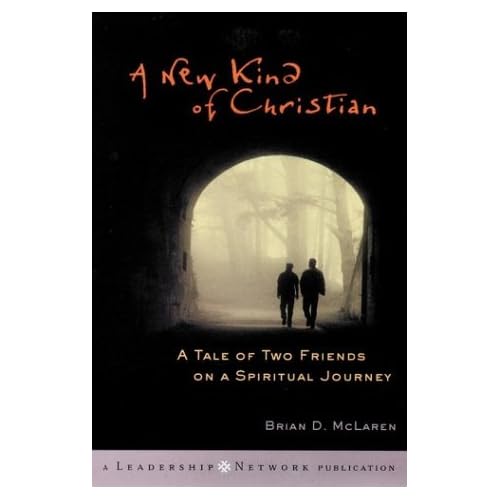
As mentioned before A New Kind of Christian has been an influential book on the Emergent culture as well as my own life. In fact, I was the lone defender of the book in a graduate school class filled with opponents of McLaren.

On the positive side ANKOC presents its case in a narrative form. This is incredibly appealing. It is engaging and easy to read. The other strength of the book is that it is more than skin deep. Its critique is not simply "Jesus is OK with Beer, so in your face Fundies!" It goes down to the root of why we think what we think. It rightfully roots out our dependence as Christians on enlightenment presuppositions. This is superb and a needed critique. As Neo (a character) dismantles Dan's (another character)world, I felt my own beliefs coming apart in a good way. I followed Dan on his journey as it mirrored my own. Many of the constructions that we have called church in the past 100 years don't reflect the biblical model very well. I am so with McLaren here.


The difficulty lies in what comes next for Dan (who receives no real resolution even in the series finale)and for us. Are we to chuck the entire denominational (or non-denominational) model? Where do we start new? If our presuppositions are flawed (and both Neo and I believe they are) who gets to call the shots? Is it everyman for themselves? If not, is it every church for itself? Who becomes the authority for doctrine and practice? Is anything out of bounds?

At the end of the day, my question for McLaren is this:

What constitutes Christianity?

And if I disagree with your answer, how do we know who is right?


It seems to me that ANKOC takes deconstruction to a point of no return.

But I could be wrong, I'll be the first to admit it.

Monday, February 4, 2008

A Journey of UnEmergence pt. 2: Lazy-boy on a La-Z-Boy

So I wasn't familiar to any of the emergent literature during my time in Fundy bible colleges, but somehow, about the time I got married, I stumbled onto a copy of A New Kind of Christian (ANKOC). I put it aside in the hustle and bustle of getting married and starting a new job with Starbucks. About a month after I got married (this puts us in about February of '04) I picked the book up and started reading it on breaks at work. I was entranced. McLaren's writing style was hypnotique. Never before had I read theology in a narrative sense. On top of the style, the substance of his critique resonated deeply with me.

Perhaps a bit of autobiography is in line at this point. I had just spent two years at a Fundy bible school. I was a bit of a theological malcontent and a I had a bit of disdain for the rules and structure (especially in my second year); but I wasn't a "bad" kid per se. Nevertheless, I was asked never to set foot on the campus again due to "theological differences". In their minds, you could not separate theology from morality, and so my "bad" theology was the result of my poor morality.

This false idea of tying morality and theology together was a prime example of the things McLaren was writing against. Like a ugly kid who finally found a date, I embraced McLaren's way of thinking whole heartedly. The problem however was that the lifestyle that McLaren spoke of was by-in-large radically different than the way I was living. He really was advocating what seemed to me to be a new kind of Christianity.

I can vividly remember sitting in my green La-Z-Boy chair weeping and thinking, "O No, I am going to have to change my life. What if Ange doesn't like the changes I feel so false".

Well, luckily for me, ANKOC didn't cause a divorce, but it did cause me to begin to think in different directions. I immediately signed up for a budding new publication called Relevant Magazine. In fact, the first one I got looked like this.

I began to visit Mars Hill Church on vacation to Michigan. I started reading every piece of literature that the fledgling movement could produce. I began to explore the ideas of totally scrapping Christianity as I had come to know it. I questioned my ability to continue my job at a denominational church. I was on a mission. I had plans. I would work for Starbucks in management, and plant a church on the side.

The problem was, no matter how much I resonated with the movement, I was frustrated by its tone. It was all critique and no construction. I didn't know how to deal with this. And so, turned off by the strong negativity I kept searching, still holding on to the Emergent...

Wednesday, January 30, 2008

A Journey of UnEmergence pt. 1

So the next few posts are going to deal with what has come to be known as the "Emergent" church. Since not every one is familiar with the term or the players in the movement, this first post will serve to set the table for the rest.

The "Emergent" church movement has grown out of the two major movements in late twentieth century evangelicism. The emergent church is self-conscientiously critical of both fundamentalism and seeker-sensitivism. The movement
has reacted to both the moral legalism of fundamentalism and the showy/falseness of the seeker-sensitive movement. At first glance these critiques are valid and attractive. We will explore these deeper in the following posts, but for now, it will suffice to say that the movement reacts strongly to the church of the twentieth century. The movement also has some relationship to postmodernism, sometimes billing itself as postmodern Christianity.

The movement began in the late 90's with the founding of a number of churches. Churches like Mars Hill (Michigan), Vintage Faith, Watermark, Solomon's Porch, Imagio Dei, and Mars Hill (Washington)began to pop-up in major cities. These churches were a haven for disenfranchised 20-somethings who were largely ignored by mainstream Christianity. The church
es often had no denominational ties and no authority structure beyond the Pastor/founder/planter/leader/whatever.

The movement began to gain a great deal of popularity with the publication of A New
Kind of Christian by Brian Mclaren. The book picked up steam as the new century began. The fictional account of a Pastor struggling with his faith resonated with a large section of the population. This book lead to the success of Blue like Jazz and Searching for God Knows What by Donald Miller. After this the floodgates opened and everyone who was anyone in the budding movement was published.

As the movement grew, there was a natural fracturing and fact
ioning of the congregations. There was a continuum of how much of the past we are to hold onto.

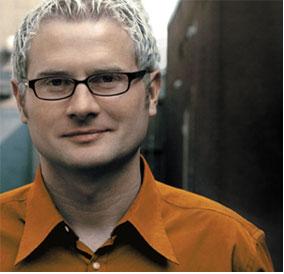
At the present time, the key players in the movement are Brian Mclaren a pastor turned lecturer and author. Rob Bell (pictured to the right), a pastor of a large church in west Michigan and the teacher in the Nooma films. Mark Driscoll, an interesting charcater since he is often lumped into the movement, but against his will.

The movement has birthed a magazine - Relevant, an imprint - Zondervan/Emergent YS, and a huge following among the internet generation.